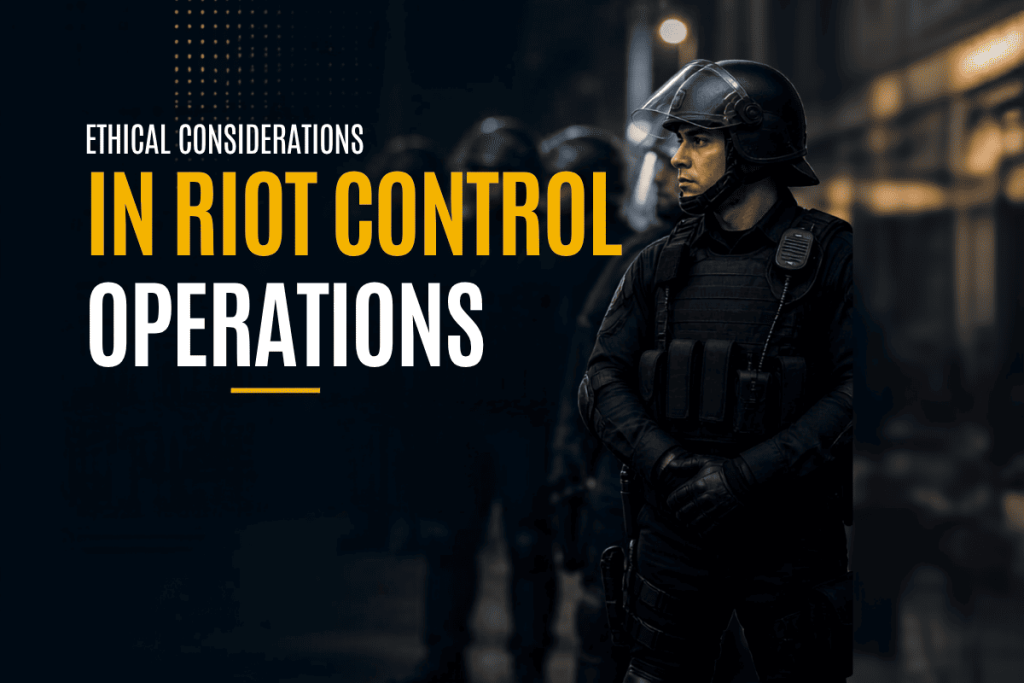
Riot control is a necessary but burdensome task for law enforcement. Too much aggressive control can strip people of their rights. Control should not only focus on safety, but be ethical and legal.
After a number of issues related to control and safety, all around the world people have been trying to understand control and safety in the same way. This involves using ethical practices in control.
What is Riot Control?
Riot control is the management of violent crowds. Court orders, protests, and civil unrest all require control.
Control methods impact the public’s perception of law enforcement.
Matters of control aim to reduce the public’s perception of order.
Control and Safety of Violence
In terms of the control of violence, safety goes first.
- Control describes three ideas:
- Safety entails maintaining threat multipliers
- Proportional controlling is not having the same sort of control failures.
For instance, controlling protestors with violence is considered a failure of riots and control. Control involves regulation and peace. Without these in control, it is considered unethical and often violent.
Global institutions, such as the UN, advocate that law enforcement should use the least amount of force possible when other methods have failed.
International Human Rights Law and Riot Control
International Human Rights Law must be respected while attempting to control riots and include:
- Freedom of peaceful assembly
- Freedom of speech
- Protection from arbitrary arrest or detention
Amnesty International and other organizations have highlighted situations in which law enforcement’s excessive use of force in controlling protests resulted in injuries and other violations of basic rights.
Respect and dignity must be afforded to people when things get out of control.
Non-Lethal Weapons
The use of non-lethal weapons, such as:
- Tear gas
- Rubber bullets
- Water jets
- Pepper spray
Sacrificing people’s lives is not what the use of those tools is about, but their improper use may result in injuries that may not be non-lethal.
The use of non-lethal weapons must be targeted and not indiscriminate and should be strictly controlled in use against those populations that are most vulnerable (children, the elderly, the physically and mentally challenged).
Knowing how to use the tools of riot control law enforcement in a responsible and necessary manner is the real crisis.
Accountability and Transparency
In order to be ethical, effective systems of accountability must be put in place in order to control riots. Law enforcement agencies must be held accountable for their actions, especially in the case of alleged acts of misconduct.
The use of:
- Body cameras and surveillance recordings
- Independent investigations
- Public reporting of incidents
These are the necessary acts that must be in place. Where accountability is lacking, operations may be well intended, but the measures that must be in place may result in a loss of public trust.
Training and Preparedness
Behaving ethically when managing crowds should not be left to chance; it requires systematic training of personnel involving:
- De-escalation methods
- Principles of crowd dynamics
- Dispute settlement
- International human rights norms
Personnel who have been trained to understand crowd behavior and dynamics will be less likely to resort to force in ordering a crowd. These personnel will also be likely to make sound judgments in high-stakes situations.
The Importance of Communication
Apart from systematic training, having a well-thought-out and well-structured communication strategy for ordering a crowd is vital for maintaining morality during a riot.
Authorities can exercise their command in an ethical manner by:
- Stating regulations and what is expected from the public
- Providing a warning before using force
- Suggesting alternate, safer, paths to ease a crowd.
A well-thought-out communication strategy should minimize the confusion and panic of a crowd, and thus make it easier to manage the crowd through non-violent means.
The Role of the Media and Public Opinion
Unlike before, today riot control situations can be filmed and posted on the Internet in a matter of minutes. It takes mere moments for the public to establish whether an authority has acted in an ethical manner or otherwise.
The use of excessive force can lead to:
- Public anger against authorities
- Lack of Trust towards authorities
- Widespread ungoverned contempt
- Ethical chaos in the order of authority
The Pursuit of a Greater Good
This is often an ethical conundrum in riot control systems. Riots to express contempt and grievance usually lead to the destruction of property. However, this must be balanced with the individual’s rights to freedom, expression, and protest.
Tension and chaos can occur with the low or no policing of a riot. Order can be achieved through the right policing and balanced use of ethics.
Cultural and Social Sensitivity
Cultural and social plus political contexts shape crowd behavior. What is most appropriate in one situation may be the most inappropriate in the other.
Ethical considerations for riot control must include:
- Social customs and standards
- Past social and political conflict
- Social interaction within the community
Poorly considered heavy-handed tactics destroy the social fabric and will most likely aggravate what was being contained.
Global Incidents
Recent protests have demonstrated the various and often opposing outcomes of riot control by one country. In contrast to that, the demonstrated control and management of the crowds has prevented successful outcomes. Loss of life, injury of bystanders, and damage to public property will also result in loss of confidence in government and the control of the crowds will justify loss of life and injury of bystanders.
Evolution of Riot Control
Crowd control tactics now include breaches of the social contract (social contract, deployment) of civil protection.
Prior to the establishment of civil protection to breach the social contract of civil protection, the social contract will be breached.
Realities of balancing the social contract of civil protection, accounting and documenting social control.
Choose Responsible Less-Lethal Solutions
Responsible riot control requires the right balance of safety, effectiveness, and accountability. Combined Systems develops American Less-Lethal Equipment and advanced tactical solutions that help law enforcement agencies manage challenging situations while supporting responsible use of force practices.
FAQs
What are the social contracts for the protection of civil society that guide riot control?
Care and concern for the protection/control of civil society, protection of civil society, control, and preservation of civil society, protection and preservation of civil society.
3. What is the importance of responsibility in riot control?
Responsibility balances the use of power by law enforcement in a way that is legal, ensures the reason for the enforcement, and encourages the public to maintain their trust in the system.
4. What methods exist for the peaceable control of riotous behavior?
Planned systems, training, and the use of verbal and non-verbal negotiation and force techniques would eliminate the only need for a minimal use of force in many situations.
5. How can the use of technology in riot control be continued in a legally and morally ethical manner?
With technology assisting in monitoring and aiding in the best decisions to be made, if employees at the control points are made aware of the current technology, training can be continued for legally and morally ethical control.
The control of riots ethically and morally goes beyond the need to preserve order. Considering the control and dignity of malpractices, a society can ensure the safety of its citizens by enforcing laws with order and control.